
Struggling with the high cost of original brand filter tapes for your air monitors? These expenses quickly add up, hurting your lab's budget and operational efficiency.
China can produce affordable filter tape rolls[^1] because a huge domestic need for air monitoring drove local innovation. Factories reverse-engineered expensive imported consumables, creating high-quality, compatible alternatives at a fraction of the price by leveraging local manufacturing advantages[^2] and supply chains.

I've been in the laboratory filtration industry for over 20 years, and I've seen this change happen firsthand. It all started with a problem we faced right here in China. The solution we developed for ourselves is now something that can benefit labs all over the world. You might be surprised at the story behind these seemingly simple consumables. Let's explore how this capability came to be and what it means for your procurement strategy[^3] today.
How did China's own environmental needs create this market?
China's rapid growth came with a serious side effect: air pollution. This created a massive, urgent domestic market for air quality monitoring[^4], which kickstarted local manufacturing innovation.
After 2008, China invested heavily in a national air monitoring network[^5], importing thousands of instruments. The high cost of their consumables created a huge opportunity for local factories[^6] like ours to develop affordable, high-performance alternatives[^7] to serve this new internal demand.
[^4] station with instruments visible inside](http://huaenv.com/wp-content/uploads/2025/11/unnamed-file-1.jpg)
I remember the years after the 2008 Olympics very clearly. The country was developing at an incredible speed. But with this progress came a new problem that everyone could see and feel: air pollution. The term PM2.5 went from a scientific term to a daily topic of conversation for everyone. The government knew it had to act. This led to a massive national project to build a comprehensive air quality monitoring[^4] network across the country.
The Rush to Monitor
To get the best data, China imported thousands of advanced monitoring instruments from the West. One of the most common models was the Met One Instruments BAM 1020, a reliable workhorse for particulate matter measurement. Suddenly, every major city needed these machines, and they needed them running 24/7.
A New Demand is Born
This created an unprecedented demand not just for the instruments, but for their essential consumables. Every single one of these machines required a steady supply of glass fiber filter tape[^8] to operate. This wasn't a small-scale lab need; it was a nationwide industrial-level demand. We suddenly had a captive market of thousands of instruments, all needing the exact same part, creating the perfect conditions for specialized local manufacturing to emerge.
What were the problems with using only imported filter tapes?
Using only imported tapes was incredibly expensive and created supply chain risks[^9]. Labs faced high operational costs and the constant worry that a delayed shipment could halt monitoring operations completely.
The main problem was cost. Original brand filter tapes were priced for Western markets, making them unsustainable for China's large-scale network. This high price, combined with long lead times, forced us to find a better, more economical solution to keep our monitors running.

Once the monitoring network was set up, the reality of operational costs hit hard. As a factory specializing in filtration, we were close to the labs and technicians running these new instruments. We heard their frustrations directly. The initial investment in the Met One monitors was one thing, but the recurring cost of the filter tape was a constant budget battle for them. I spoke with a procurement manager for a regional environmental agency who told me, "The cost of one roll of tape from the original brand is staggering. We have dozens of stations, and this single consumable is one of our biggest annual expenses."
The Challenge of Cost and Supply
The problem was twofold. First, the price was simply too high. Second, the supply chain was long and unreliable. Here’s a breakdown of the challenges our clients faced:
| Challenge | Impact on Lab Operations |
|---|---|
| High Unit Price | Drastically increased the annual operating budget. Made it difficult to expand the monitoring network or allocate funds to other critical areas. |
| Long Lead Times | Shipments from Europe or the US could take weeks or months. Any customs delay could lead to a stockout. |
| Supply Instability | Labs had to overstock to avoid running out, tying up capital in inventory. A single supply chain disruption abroad could shut down monitoring stations. |
| Lack of Flexibility | There was no room for negotiation or customization. You had to take the one product offered at the price they set. |
This situation was not sustainable. We couldn't rely on a single, expensive, and distant supplier for a component that was critical to our national environmental security. The market was desperate for an alternative. It needed a product with the same performance but at a reasonable cost and with a reliable, local supply. That is the exact problem we set out to solve.
How do Chinese manufacturers ensure quality while keeping costs low?
We focus on the essentials: high-quality raw materials, efficient processes, and direct-to-market models. By eliminating brand markups and optimizing production, we deliver OEM-level quality[^10] without the high price tag.
We combine high-grade glass microfiber[^11], identical to that used by major brands, with our 20+ years of manufacturing expertise. By controlling the entire process in-house and selling directly, we cut out middlemen, passing the significant cost savings directly on to you.

As a factory with deep roots in OEM/ODM manufacturing for laboratory filtration, we saw the high cost of imported filter tapes not as a barrier, but as an engineering and business challenge. We knew we could make a compatible product. The real question was, could we make one that was just as good, or even better, for a fraction of the cost? The answer is yes, and it comes down to a few key principles we live by.
Focusing on What Matters
We started by deconstructing the original product. The core of any filter tape is the filter media itself. We sourced the same high-purity, binderless glass microfiber that top brands use. The performance is in the material, not the brand name on the box.
Leveraging Manufacturing Expertise
Our advantage lies in our process. With over 20 years of experience and 8 dedicated production lines, we have perfected the art of wet-laid processing[^12] and precision slitting[^13].
- Wet-Laid Process: This ensures a uniform fiber distribution, which is critical for consistent airflow and accurate particulate capture.
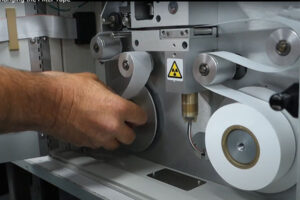
- Precision Slitting: Our CNC machines cut the tape to exact widths with tight tolerances (±0.1mm), ensuring perfect compatibility and preventing jams in sensitive instruments like the BAM 1020.
- ISO-Certified Cleanroom: All production happens in an ISO 9001 certified cleanroom[^14] environment to prevent any contamination that could affect sensitive measurements.
Here is how we control costs without compromising quality:
| Cost-Saving Factor | How It Benefits You |
|---|---|
| Local Raw Material Sourcing | Reduces shipping costs and import tariffs on bulky raw materials. |
| In-House Production | We control every step, from making the media to slitting and packaging. No outsourcing costs. |
| OEM/ODM Business Model | We don't have massive marketing budgets or brand royalties to pay. We focus on production. |
| Economies of Scale | The huge initial domestic demand allows us to produce in large volumes, lowering the cost per unit for everyone. |
By combining these factors, we can provide a filter tape roll that meets or exceeds OEM specifications for performance and reliability, all while offering it at a price that makes sense for your budget.
Conclusion
China's unique environmental journey created a need for affordable monitoring consumables. Local manufacturers like us stepped up, creating high-quality, cost-effective filter tape rolls that now benefit labs worldwide.
[^1]: Explore how affordable filter tape rolls can significantly reduce your lab's operational costs while maintaining quality. [^2]: Understand how local manufacturing can lead to cost savings and improved supply chain reliability. [^3]: Get tips on developing an effective procurement strategy that balances cost and quality. [^4]: Learn about the critical role of air quality monitoring in safeguarding public health and the environment. [^5]: Learn about the components and functions of a national air monitoring network. [^6]: Understand the role of local factories in providing affordable and reliable lab supplies. [^7]: Discover innovative alternatives that can enhance lab efficiency without breaking the bank. [^8]: Get insights into the importance of glass fiber filter tape in ensuring accurate air quality measurements. [^9]: Explore the potential pitfalls of relying on imported consumables and how to mitigate them. [^10]: Learn about the standards and expectations of OEM-level quality in laboratory products. [^11]: Discover the significance of high-grade glass microfiber in producing reliable lab consumables. [^12]: Understand the wet-laid processing technique and its benefits for filter tape performance. [^13]: Find out how precision slitting enhances the performance and reliability of filter tapes. [^14]: Learn how ISO 9001 certification ensures quality and safety in manufacturing processes.