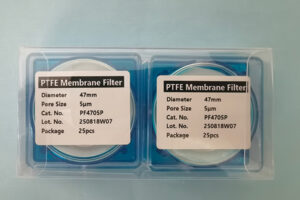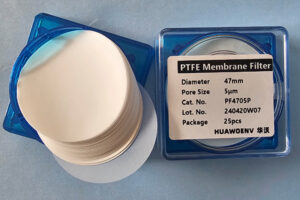

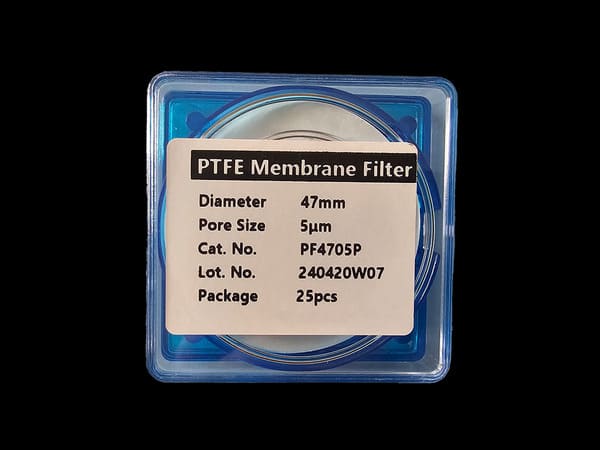
PTFE membrane filters[^1] offer unparalleled performance for critical filtration needs. Their chemical inertness, temperature stability, and hydrophobic nature make them invaluable in challenging environments.
PTFE membrane filters are highly stable up to 260°C (500°F)[^2], chemically inert[^3], and naturally hydrophobic[^4], making them excellent for aerosol sampling, air venting, and gas filtration[^5], especially where water vapor is present.
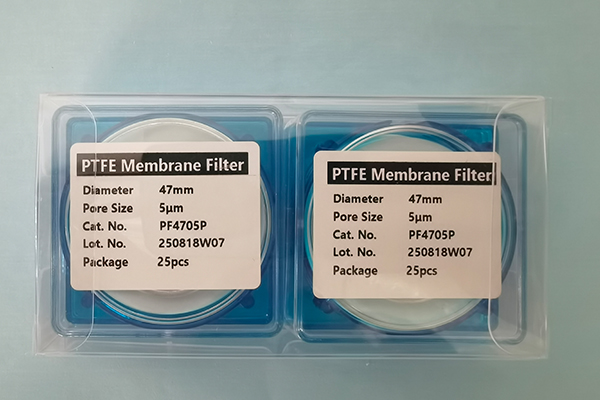
PTFE filters are widely used across industries for their unique properties, but their manufacturing process is equally fascinating. Let’s explore this in detail.
What makes PTFE filters chemically inert and unique?
PTFE filters are made from pure expanded polytetrafluoroethylene (ePTFE)[^6], a material renowned for its stability. Unlike other membranes, PTFE resists chemical reactions even in harsh environments.
PTFE’s inertness allows it to remain stable when exposed to acids, bases, and solvents[^7], making it ideal for industrial filtration applications.

PTFE filters are non-reactive even under extreme conditions. This property is crucial for applications where exposure to aggressive chemicals might damage other filtration materials. The hydrophobic nature of PTFE also helps in environments where moisture could compromise performance.
How do PTFE membranes handle high temperatures?
PTFE membranes remain stable at temperatures up to 260°C (500°F). This makes them suitable for filtration in high-temperature processes.
PTFE membranes exhibit excellent thermal stability, ensuring reliable performance in applications such as hot gas filtration and high-temperature sampling[^8].

The ability to withstand extreme heat without degradation gives PTFE filters a clear advantage over other materials. This versatility is vital for industries like energy, automotive, and chemical processing.
Why are PTFE membranes hydrophobic?
PTFE membranes naturally repel water due to their unique molecular structure. This property ensures effectiveness in air and gas filtration where water vapor or aerosols are present.
PTFE’s hydrophobicity prevents clogging and maintains efficiency[^9], making these filters ideal for aerosol sampling and venting applications.
This hydrophobic quality ensures smooth airflow and prevents water interference in filtration processes. It also allows for better sampling accuracy in environments with high humidity or water vapor.
How are PTFE filters manufactured for uniformity and efficiency?
PTFE filters are manufactured using a patented process to create high-porosity, uniformly thick, thermostable membranes[^10]. This ensures consistency and reliability in applications.
The patented ePTFE manufacturing process guarantees membranes with uniform thickness, superior porosity, and remarkable thermostability, enhancing filtration efficiency.

The precision involved in their production ensures that these filters meet global environmental monitoring standards[^11]. Their uniform structure eliminates imperfections that could compromise filtration performance.
Why choose HuaEnv for PTFE filters?
HuaEnv specializes in high-quality, customizable PTFE filters and other laboratory filtration materials. With over 15 years of experience, we manufacture products that meet strict international standards.
HuaEnv offers PTFE filters with exceptional quality and competitive pricing, making us a trusted partner for distributors and environmental monitoring companies.
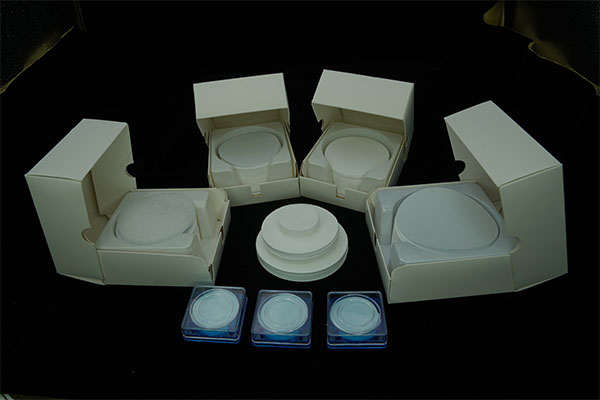
Our filters are perfect for global distributors and laboratories needing reliable filtration solutions. We provide free samples to help our partners evaluate our products before committing to bulk orders.
Which industries rely on PTFE filters?
PTFE filters are essential in industries like environmental monitoring, pharmaceuticals, food and beverage, automotive, and energy. Their adaptability makes them a preferred choice for diverse applications.
Industries use PTFE filters for air and water monitoring, aerosol sampling, air venting, and gas filtration, ensuring operational efficiency and regulatory compliance.
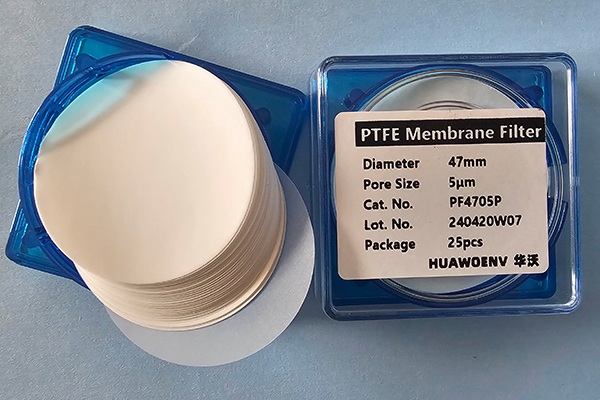
From PM2.5 monitoring membranes to quartz filter papers, PTFE filters are indispensable in ensuring clean air and water while maintaining high-performance standards.
Conclusion
PTFE membrane filters are invaluable for critical filtration tasks due to their chemical inertness, hydrophobicity, and thermal stability. HuaEnv offers globally trusted, high-quality PTFE filters backed by expertise and precision.
[^1]: "[PDF] Quality Assurance Guidance 2.12 - Monitoring PM2.5 In Ambient Air ...", https://www.epa.gov/sites/default/files/2021-03/documents/p100oi8x.pdf. A materials-science source describing PTFE’s chemical inertness, hydrophobicity, and high service temperature supports the stated performance characteristics of PTFE membrane filters in air, aerosol, and gas-filtration contexts. Evidence role: general_support; source type: paper. Supports: PTFE membrane filters are highly stable up to 260°C (500°F), chemically inert, and naturally hydrophobic, making them excellent for aerosol sampling, air venting, and gas filtration, especially where water vapor is present.. Scope note: One source may not cover every listed application; separate standards or methods may be needed for aerosol sampling, air venting, and gas filtration uses.
[^2]: "Understanding Perfluoroalkoxy Alkane: The High-Performance ...", https://blogs.bu.edu/duartede/understanding-perfluoroalkoxy-alkane-the-high-performance-polymer/. A polymer reference source should document PTFE’s typical continuous service-temperature range around 260°C, supporting the stated upper-use temperature for PTFE membranes. Evidence role: general_support; source type: encyclopedia. Supports: PTFE membrane filters are highly stable up to 260°C (500°F).. Scope note: The cited value generally applies to PTFE as a polymer; actual membrane performance also depends on pore structure, backing material, and application conditions.
[^3]: "Polytetrafluoroethylene - Wikipedia", https://en.wikipedia.org/wiki/Polytetrafluoroethylene. A neutral polymer chemistry source should explain that the strong carbon-fluorine bonding in PTFE contributes to its unusually low chemical reactivity. Evidence role: mechanism; source type: education. Supports: PTFE is chemically inert because of its molecular structure.. Scope note: This supports the general chemical inertness of PTFE, not the performance of every commercial PTFE membrane formulation.
[^4]: "Water can't touch this sanded, powdered surface - Rice News", https://news.rice.edu/news/2022/water-cant-touch-sanded-powdered-surface. A materials-science source should report that PTFE has a low surface energy and high water contact angle, which accounts for its intrinsic hydrophobic behavior. Evidence role: mechanism; source type: paper. Supports: PTFE is naturally hydrophobic.. Scope note: Hydrophobicity can vary with membrane roughness, surface treatment, and contamination, so the source would support the material property rather than every product condition.
[^5]: "[PDF] PARTICULATE MATTER (PM2.5 ) SPECIATION GUIDANCE Final ...", https://www.epa.gov/sites/default/files/2017-01/documents/final_draft_pm2.5_speciation_guidance_1999.pdf. A governmental or standards source should show that PTFE filters are specified or commonly used for aerosol or particulate sampling, supporting their suitability in gas-phase filtration contexts. Evidence role: case_reference; source type: government. Supports: PTFE membrane filters are suitable for aerosol sampling, air venting, and gas filtration.. Scope note: Such sources may verify one regulated use, such as particulate sampling, rather than all listed applications equally.
[^6]: "Effects of expanded polytetrafluoroethylene porous membrane ...", https://bioresources.cnr.ncsu.edu/resources/effects-of-expanded-polytetrafluoroethylene-porous-membrane-covering-and-biochar-on-nitrogen-phosphorus-and-potassium-contents-in-aerobic-compostin/. A technical reference should define expanded polytetrafluoroethylene as a porous form of PTFE produced by expansion or stretching, supporting the description of ePTFE membrane material. Evidence role: definition; source type: encyclopedia. Supports: PTFE filters are made from expanded polytetrafluoroethylene, a porous PTFE material.. Scope note: The source may define ePTFE generally and may not establish that all PTFE filters are made from pure ePTFE.
[^7]: "[PDF] CHEMICAL COMPATIBILITY CHART", https://www.wisconsin.edu/ehs/download/Fisher-Scientific-Chemical-Compatibility-Chart.pdf. A chemical-resistance reference should document PTFE’s broad resistance to acids, bases, and many solvents, supporting the claim that it remains stable in aggressive chemical environments. Evidence role: general_support; source type: institution. Supports: PTFE remains stable when exposed to acids, bases, and solvents.. Scope note: Chemical resistance depends on concentration, temperature, exposure time, and the presence of additives or support layers.
[^8]: "Development of a High-Purity Filter for High Temperature Particulate ...", https://nepis.epa.gov/Exe/ZyPURL.cgi?Dockey=9101JRNN.TXT. A standards, laboratory, or technical source should identify PTFE membranes as usable in elevated-temperature gas or particulate sampling, supporting the stated high-temperature filtration applications. Evidence role: case_reference; source type: government. Supports: PTFE membranes can be used in hot gas filtration and high-temperature sampling.. Scope note: The evidence may support particular sampling methods or ranges rather than every hot-gas filtration scenario.
[^9]: "[PDF] PTFE Membrane Filters", https://www3.epa.gov/ttnemc01/methods/m202doc15.pdf. A filtration or membrane-science source should explain that hydrophobic membrane surfaces resist liquid-water intrusion under appropriate pressure conditions, helping preserve airflow in gas filtration. Evidence role: mechanism; source type: paper. Supports: PTFE’s hydrophobicity helps prevent water-related clogging and maintain filtration efficiency.. Scope note: Hydrophobicity reduces water wetting but does not eliminate clogging from particulates, oils, surfactants, or pressure exceeding the membrane’s water-entry pressure.
[^10]: "Expanded Polytetrafluoroethylene Membranes for Vascular Stent ...", https://pmc.ncbi.nlm.nih.gov/articles/PMC9967047/. A patent or historical technical source should describe the expansion process used to produce porous PTFE membranes, supporting the statement that ePTFE manufacturing has patented origins and can yield porous membranes. Evidence role: historical_context; source type: government. Supports: PTFE filters can be manufactured through patented ePTFE processes that create porous, thermostable membranes.. Scope note: A patent can show that such a process exists, but it does not prove that all current PTFE filters use the same process or that every product has uniform thickness.
[^11]: "Appendix L to Part 50, Title 40 -- Reference Method for the ... - eCFR", https://www.ecfr.gov/current/title-40/chapter-I/subchapter-C/part-50/appendix-Appendix%20L%20to%20Part%2050. An environmental agency or standards document should specify requirements for filter media used in particulate-matter monitoring, such as PTFE filter characteristics, supporting the claim that PTFE filters are used in regulated monitoring contexts. Evidence role: case_reference; source type: government. Supports: PTFE filters can meet environmental monitoring standards for applications such as particulate-matter sampling.. Scope note: A national standard, such as an EPA method, would support compliance within that jurisdiction and may not establish all global standards.