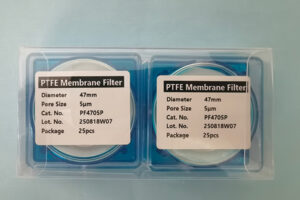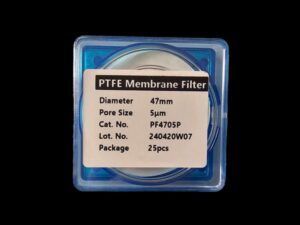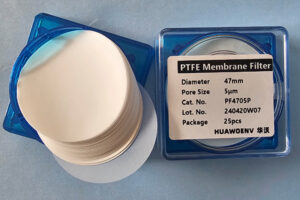

The high price of Millipore LSWP04700 PTFE membrane filters burdens end users. This cost often impacts their budgets for critical air sampling tasks. Could there be a better option?
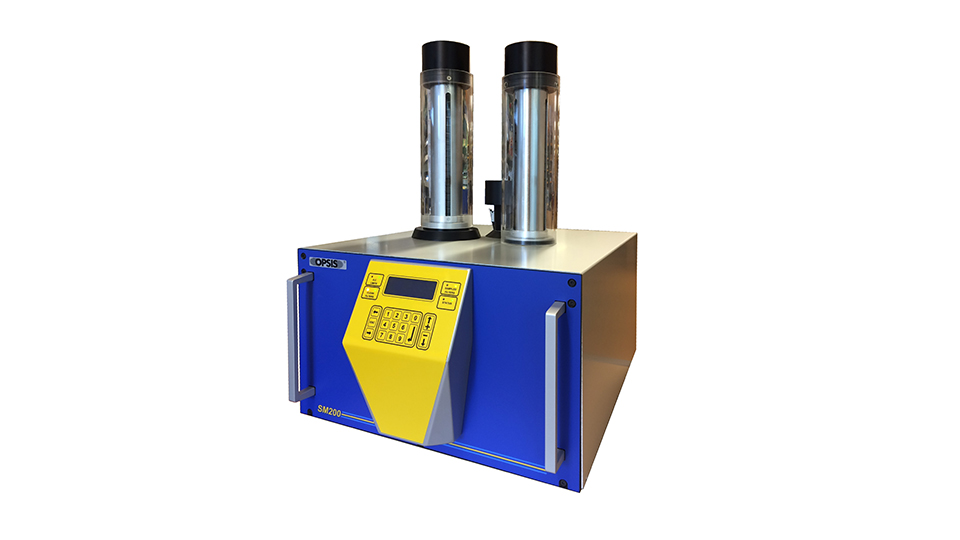
PTFE membranes used in OPSIS particle monitor SM200 filter sampled air effectively.[^1] The 47 mm Teflon filter captures particles during sampling, enabling accurate PM concentration measurements through beta absorption.[^2]
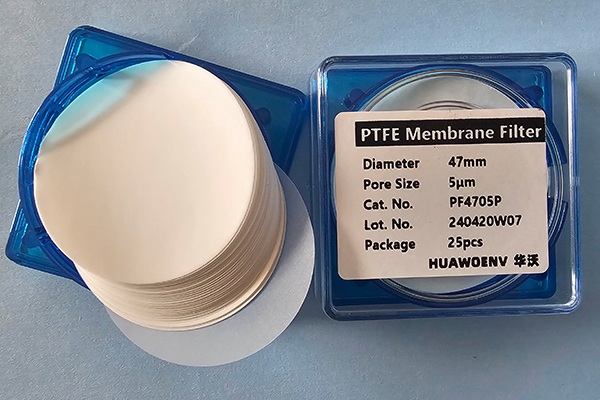
The demand for reliable, cost-effective filters suitable for air monitoring systems like OPSIS SM200 is growing.[^3] Let me share why PTFE membranes are key, how they work, and why alternatives like HuaEnv products could benefit users worldwide.
Why are PTFE membranes used in OPSIS particle monitor SM200?
PTFE membranes are known for their durability, high filtration efficiency, and chemical resistance[^4]. This makes them ideal for monitoring particulate matter in air.[^5]
During sampling, air passes through a 47 mm PTFE membrane filter, where particles accumulate.[^6] The beta absorption method measures particle weight[^7], helping calculate PM concentrations accurately.
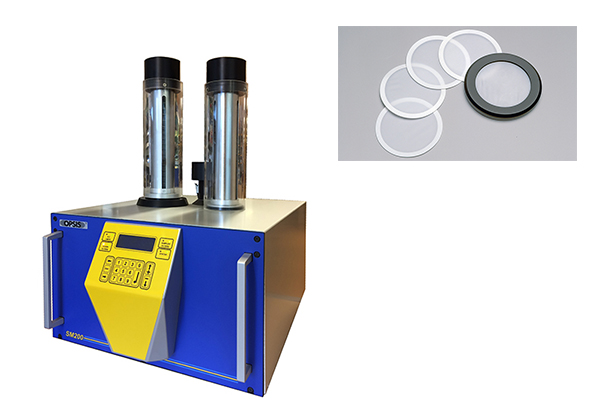
Particle monitoring systems like OPSIS SM200 depend on filters that ensure consistent results, even when exposed to varying conditions. However, the high costs of premium brands like Millipore often challenge end users[^8], pushing them to seek viable alternatives without compromising quality.
Dive deeper: How does beta absorption work for PM measurement?
To measure particulate matter concentration, the beta absorption method starts by weighing the particles collected on the filter. This weight is then compared to the total air volume sampled during the exposure period.
| Measurement Steps | Description |
|---|---|
| Particle Accumulation | Collected particles settle on the 47 mm PTFE membrane filter. |
| Beta Absorption Analysis | Beta rays determine particle weight on the filter surface. |
| Final Calculation | Weight combined with total sampled air volume gives PM levels.[^9] |
For daily average PM concentration limits[^10], filters like those used in OPSIS SM200 play an important role. They allow sampling over various durations, ensuring flexibility for users.
Is there a cost-effective alternative for PTFE membranes?
Many end users rely on Millipore products, such as the LSWP04700 PTFE membrane filter. But their high price increases operational costs, making air monitoring less affordable.
HuaEnv manufactures PTFE membranes for air monitoring with global quality standards.[^11] These membranes provide durable filtration at a fraction of the cost.[^12] Free samples are available for distributors worldwide.
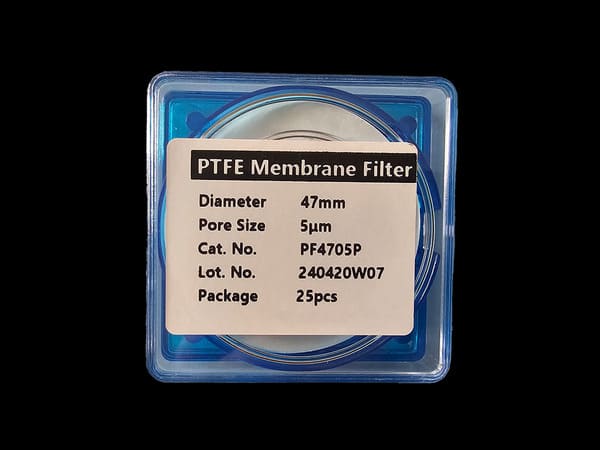
As a factory specializing in air & water monitoring filters, HuaEnv offers membranes designed for PM measurement systems like OPSIS SM200. By adopting HuaEnv products, users can reduce costs while maintaining accurate monitoring results.
Dive deeper: How does HuaEnv ensure quality in PTFE membranes?
HuaEnv’s production focuses on precision and consistency. Here’s how we ensure our filters meet stringent requirements:
| Quality Control Process | Details |
|---|---|
| Material Testing | PTFE membranes tested for chemical resistance and porosity. |
| Dimensional Precision | Cut to exact 47 mm size, ensuring compatibility with OPSIS SM200. |
| Filtration Efficiency | Verified filtration rates for PM 2.5 and PM 10 monitoring. |
| Batch Inspection | Every batch undergoes physical and performance checks. |
OEM partnerships allow HuaEnv to customize filters for specific needs, including varying pore sizes and chemical compatibility, making them an excellent choice for labs and service companies.
How can users access HuaEnv’s filters?
Global distributors and environmental service companies can easily explore HuaEnv’s product range. The company specializes in air sampling filters, quartz filter papers, and PM2.5 membranes.
HuaEnv provides free samples for evaluation, helping users verify quality and compatibility with their systems before committing to bulk purchases.
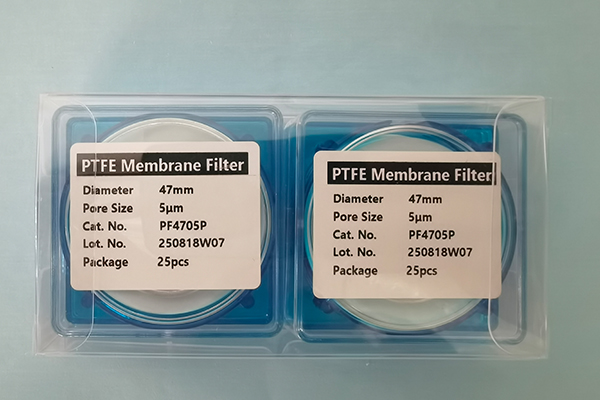
By offering free samples, HuaEnv empowers users to test filters like those used in OPSIS SM200 monitors. It’s an opportunity to reduce costs while maintaining reliable PM monitoring results.
Here’s a comparison between HuaEnv filters and premium brands like Millipore:
| Feature | HuaEnv PTFE Membranes | Millipore LSWP04700 |
|---|---|---|
| Price | Affordable for bulk purchases. | High cost per filter sheet. |
| Customization | Pore size, dimensions, and chemical options available. | Limited customization. |
| Global Availability | Samples and shipping offered worldwide. | Restricted to select regions. |
| Quality Standards | Meets ISO filtration standards. | Known for consistent quality. |
For air monitoring systems requiring PTFE membranes, HuaEnv provides a budget-friendly alternative without sacrificing reliability.
Conclusion
PTFE membranes are essential for particulate monitoring in systems like OPSIS SM200. While premium brands like Millipore offer exceptional quality, the high costs burden end users. HuaEnv’s filters provide a cost-effective alternative, ensuring reliable PM measurement at affordable rates.
[^1]: "Environmental Technology Verification Report OPSIS AB SM 200 ...", https://nepis.epa.gov/Exe/ZyPURL.cgi?Dockey=P101BSGC.TXT. A technical manual or independent method description should document that the OPSIS SM200 uses membrane filters for particulate sampling and that collected particulate matter can be retained for subsequent mass determination. Evidence role: case_reference; source type: other. Supports: The OPSIS SM200 uses PTFE membrane filters to sample airborne particles effectively.. Scope note: Support may verify the SM200 sampling configuration rather than independently proving comparative sampling effectiveness.
[^2]: "[PDF] MET ONE INSTRUMENTS BAM 1020 PARTICLE MONITOR", https://archive.epa.gov/nrmrl/archive-etv/web/pdf/01_vr_metone_bam1020.pdf. A standard-method source should support that particulate matter can be collected on membrane filters and quantified by beta attenuation or beta absorption methods to derive ambient PM concentrations. Evidence role: mechanism; source type: government. Supports: A 47 mm Teflon/PTFE filter can collect particles for PM concentration measurement using beta absorption or beta attenuation.. Scope note: The source may describe beta attenuation monitoring generally, not the accuracy of every 47 mm Teflon filter or instrument configuration.
[^3]: "Low–Cost Air Pollution Monitors and Indoor Air Quality | US EPA", https://www.epa.gov/indoor-air-quality-iaq/low-cost-air-pollution-monitors-and-indoor-air-quality. A market or institutional report should indicate increasing deployment or demand for ambient air quality monitoring equipment and related consumables, providing context for demand for compatible filters. Evidence role: statistic; source type: institution. Supports: Demand for reliable and cost-effective filters for air monitoring systems is growing.. Scope note: Such evidence would likely support the broader air-monitoring market trend rather than demand for filters used specifically in the OPSIS SM200.
[^4]: "Improvement of Polytetrafluoroethylene Membrane High-Efficiency ...", https://pmc.ncbi.nlm.nih.gov/articles/PMC8659273/. A polymer or membrane-filtration reference should document PTFE’s chemical inertness, thermal stability, and common use as a filtration membrane with high collection efficiency under appropriate pore-size specifications. Evidence role: definition; source type: research. Supports: PTFE membranes are valued for durability, filtration efficiency, and chemical resistance.. Scope note: General PTFE material properties do not establish the performance of any particular manufactured membrane lot.
[^5]: "[PDF] Quality Assurance Guidance 2.12 - Monitoring PM2.5 In Ambient Air ...", https://www.epa.gov/sites/default/files/2021-03/documents/p100oi8x.pdf. An ambient-air monitoring method or guidance document should show that PTFE or Teflon filters are commonly specified for gravimetric and chemical analysis of particulate matter because of their low background mass and chemical stability. Evidence role: expert_consensus; source type: government. Supports: PTFE membranes are suitable for monitoring particulate matter in air.. Scope note: The source would support suitability for established monitoring protocols, not that PTFE is uniquely ideal for every air-monitoring application.
[^6]: "Review of Filters for Air Sampling and Chemical Analysis in Mining ...", https://pmc.ncbi.nlm.nih.gov/articles/PMC10174218/. A PM sampling method should describe that sampled air is drawn through a filter of specified diameter and that suspended particles are deposited on the filter medium for measurement. Evidence role: mechanism; source type: government. Supports: In particulate sampling, air is drawn through a PTFE membrane filter and particles accumulate on the filter.. Scope note: The source may describe standard PM samplers generally and may not confirm that every OPSIS SM200 configuration uses a 47 mm PTFE membrane.
[^7]: "Beta attenuation monitoring", https://en.wikipedia.org/wiki/Beta_attenuation_monitoring. A beta attenuation monitoring reference should explain that beta radiation attenuation through a particle-loaded filter is related to deposited particulate mass, which is then used to estimate PM concentration. Evidence role: mechanism; source type: government. Supports: The beta absorption method measures or estimates particle mass collected on a filter.. Scope note: Beta attenuation estimates mass from radiation absorption; it is not the same as direct gravimetric weighing unless calibrated against reference methods.
[^8]: "PTFE Membrane Filter, 5.0 μm Pore Size: Why is it essential for your ...", https://huaenv.com/ptfe-membrane-filter-5-0-%CE%BCm-pore-size-why-is-it-essential-for-your-lab/. A price list, procurement record, or market comparison should document the unit cost of Millipore LSWP04700 or similar PTFE membranes relative to lower-cost alternatives, supporting the cost-burden context. Evidence role: statistic; source type: other. Supports: Premium PTFE filter brands such as Millipore can impose higher operating costs on end users.. Scope note: Pricing varies by region, distributor, order volume, and time, so the evidence would support a contextual price comparison rather than a universal cost burden.
[^9]: "[PDF] Determination PM2.5 Mass and PM Coarse Mass by Gravimetric ...", https://ww2.arb.ca.gov/sites/default/files/2019-02/mld055.pdf. A regulatory reference method should state that particulate matter concentration is calculated as collected particulate mass divided by the volume of air sampled, typically reported in micrograms per cubic meter. Evidence role: mechanism; source type: government. Supports: PM levels are calculated from collected particle mass and sampled air volume.. Scope note: This supports the basic concentration calculation and does not address uncertainty corrections or instrument-specific calibration procedures.
[^10]: "WHO global air quality guidelines: particulate matter (PM2.5 and ...", https://www.who.int/publications/i/item/9789240034228. A public-health or environmental standard should document 24-hour average particulate matter guideline values or regulatory limits for PM2.5 and PM10. Evidence role: statistic; source type: institution. Supports: Daily average PM concentration limits exist and are used in air-quality monitoring.. Scope note: Limits vary by jurisdiction and by whether the source is a health guideline or legally binding standard.
[^11]: "[PDF] PTFE Membrane Filters - EPA", https://www3.epa.gov/ttnemc01/methods/m202doc15.pdf. A certification record, accredited test report, or company technical dossier should verify that HuaEnv manufactures PTFE air-monitoring membranes and identify the specific quality-management or product standards applied. Evidence role: case_reference; source type: other. Supports: HuaEnv manufactures PTFE membranes for air monitoring and follows recognized quality standards.. Scope note: Certification can document management systems or tested specifications, but it does not by itself prove field equivalence with another manufacturer’s filter.
[^12]: "Low cost, high performance ultrafiltration membranes from glass ...", https://pmc.ncbi.nlm.nih.gov/articles/PMC7713439/. A combined performance test and price comparison should show that HuaEnv PTFE membranes meet specified durability or filtration-performance criteria while costing substantially less than the named benchmark product. Evidence role: statistic; source type: other. Supports: HuaEnv membranes offer durable filtration at substantially lower cost than premium alternatives.. Scope note: A price-performance comparison is time- and market-dependent and would not establish suitability for all instruments without compatibility testing.