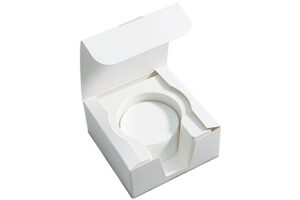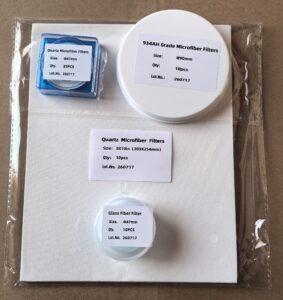


Filtration can be a tricky business, especially when it comes to Total Suspended Solids (TSS) in soil samples. Using the right filter can make all the difference.
Glass fiber filter papers are preferred for TSS analyses[^1] because they can trap more particles effectively compared to other filter materials. Their unique structure enables them to handle the large particle size distributions typically found in soils[^2].

When it comes to filtration, the type of material you choose plays a huge role. I've seen firsthand how glass fibers outperform cellulose in many scenarios. Let's dive into why glass fiber filters are often the top choice.
What makes glass fiber filters more effective for TSS?
Choosing the right filter material is crucial when analyzing TSS. Glass fibers have a unique advantage: they can hold more particles before becoming blocked[^3]. This is particularly important when dealing with the diverse particle size distributions found in soils.
Glass fibers are smaller and more uniform compared to cellulose fibers. This uniformity allows for larger void spaces, which can trap contaminants more effectively.

The efficiency of filtration also varies based on the material. For instance, cellulose fibers are rated at only 50% efficiency when filtering out 2-micron particles[^4]. This means that half of the particles slip through. In contrast, glass fibers boast an impressive 99.5% efficiency for the same pore size[^5]. This means that glass filters can trap almost all of those pesky 2-micron particles.
Understanding the filtration efficiency
Let's break down the efficiency rates a bit more. The filtration ratio efficiency is defined by how well a material can trap particles based on its pore size.
| Filter Material | Pore Size | Efficiency Rate |
|---|---|---|
| Cellulose Fibers | 2 microns | 50% |
| Glass Fibers | 2 microns | 99.5% |
As you can see from the table, glass fibers are far superior when it comes to efficiency. The difference is not just in numbers but in practical applications as well. When performing TSS tests, having a filter that traps nearly all of the particles ensures more accurate results.
Why not cellulose or other materials?
Many people still opt for cellulose filters due to their lower cost. While they may save you money upfront, the compromised efficiency can lead to inaccurate results.
Cellulose fibers can vary significantly in thickness, making it difficult to achieve a tight and uniform filter. This inconsistency can lead to incomplete filtration and skewed data.
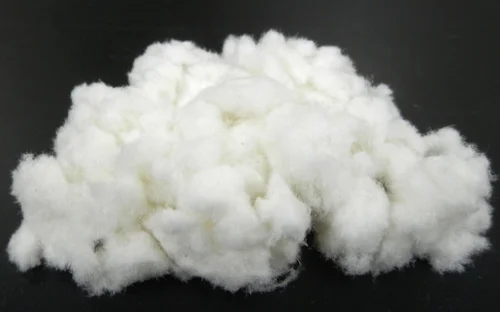
Additionally, glass fibers are more durable and can withstand higher temperatures and harsher chemicals. This durability means they can be used in a wider range of applications without compromising the filter's integrity.
Conclusion
In conclusion, using glass fiber filter papers for TSS analysis offers superior efficiency and reliability. Their ability to trap more particles makes them the ideal choice for accurate filtration in environmental monitoring and analysis.
[^1]: "NEMI Method Summary - I-3765", https://www.nemi.gov/methods/method_summary/5495/. Standard TSS methods commonly specify glass-fiber filters for gravimetric suspended-solids determination, supporting the statement that this medium is conventional for TSS analysis. Evidence role: expert_consensus; source type: government. Supports: Glass fiber filter papers are preferred for TSS analyses.. Scope note: This supports standard practice for water and wastewater TSS methods; it does not by itself prove superiority for every soil-sample preparation workflow.
[^2]: "Particle-Size Distribution Models for the Conversion of ... - PMC", https://pmc.ncbi.nlm.nih.gov/articles/PMC4121012/. Soil-science references describe soils as mixtures of particle-size classes such as clay, silt, sand, and larger fragments, providing context for why soil-derived suspensions can contain broad particle-size distributions. Evidence role: general_support; source type: education. Supports: Soil samples typically contain large or diverse particle size distributions.. Scope note: This is contextual support for soil particle-size diversity, not direct evidence about the exact particle distribution in any specific TSS sample.
[^3]: "DNA RETENTION ON DEPTH FILTERS - PMC - NIH", https://pmc.ncbi.nlm.nih.gov/articles/PMC6586439/. Filtration literature distinguishes depth filters, including fibrous glass media, from surface filters and explains that particle capture throughout the filter depth can increase dirt-holding capacity before clogging. Evidence role: mechanism; source type: paper. Supports: Glass fibers can hold more particles before becoming blocked.. Scope note: This supports the general mechanism of depth filtration; actual capacity depends on filter grade, pore structure, sample composition, and operating conditions.
[^4]: "Biodegradable cellulose-based electrostatically assisted air ...", https://www.sciencedirect.com/science/article/pii/S1385894726009617. Particle-retention studies or filter-rating references can document that nominal cellulose filter ratings may correspond to partial, not absolute, retention of particles at the stated size. Evidence role: statistic; source type: paper. Supports: Cellulose fibers are rated at only 50% efficiency when filtering out 2-micron particles.. Scope note: The exact 50% value is likely dependent on filter grade and test method, so a source must match the specific cellulose medium and efficiency definition used in the article.
[^5]: "Chemical Modification with Surface-Active Treatment - PMC", https://pmc.ncbi.nlm.nih.gov/articles/PMC11174125/. A filter-retention standard, manufacturer-independent test report, or peer-reviewed filtration study can substantiate whether a specified glass-fiber medium achieves about 99.5% retention for 2 µm particles under defined test conditions. Evidence role: statistic; source type: paper. Supports: Glass fibers have 99.5% efficiency for 2-micron particles at the same pore size.. Scope note: The statistic is not generalizable to all glass-fiber filters unless the cited source uses the same pore size, filter grade, challenge particles, and efficiency metric.