

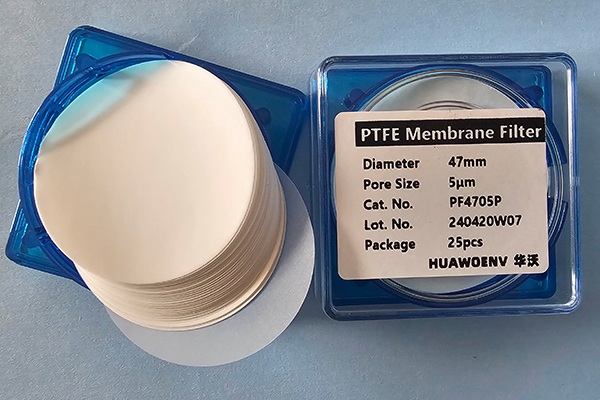
Hydrophobic PTFE membranes[^1] are incredibly versatile. They maintain their hydrophobic properties even in humid environments, making them ideal for air, gas, and chemical filtration.
Hydrophobic PTFE membranes repel water because they are made entirely of polytetrafluoroethylene (PTFE)[^2]. Unlike hydrophilic filters, these membranes stay dry even in humid air[^3]. They are commonly used for filtering air, gases, and chemicals[^4].
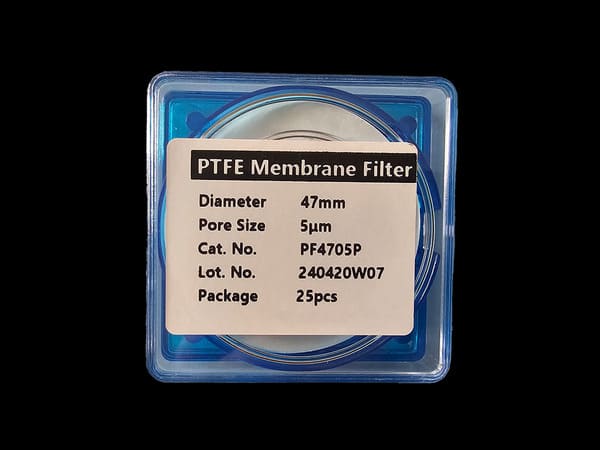
PTFE membranes are not just robust but also chemically resistant[^5]. With a pH tolerance from 1 to 14[^6], they effectively filter solvents and acids that degrade other filter types[^7]. This unique compatibility makes them essential for specialized laboratory and industrial applications.
What makes PTFE membranes ideal for air filtration?
Air filtration often requires materials that can withstand environmental moisture without losing function. Hydrophobic PTFE membranes excel in such conditions.
Hydrophobic PTFE membranes are ideal for air filtration because they repel water, ensuring consistent performance even in high-humidity environments[^8]. Their durability enables long-term exposure without compromising quality.

When air passes through the filter during sampling, particles are trapped on the membrane's surface[^9]. These filters are commonly used in air quality monitoring setups, including PM2.5 and PM10 air sampling[^10]. For instance, a 47 mm PTFE filter can collect particle matter for daily average concentration measurements[^11]. This precision is critical for regulatory compliance and environmental research.
Comparison of PTFE membranes with other filter types
| Filter Type | Material | Applications | Advantages | Disadvantages |
|---|---|---|---|---|
| PTFE Membranes | Polytetrafluoroethylene | Air, gas, solvent filtration | Hydrophobic, chemical resistance (pH 1-14) | Costlier than cellulose or glass filters |
| Glass Fibre Filters | Fiberglass | Air sampling | Affordable, high temperature resistance | Lower chemical compatibility |
| Cellulose Filters | Cellulose | General filtration | Biodegradable, inexpensive | Poor chemical resistance |
As shown above, PTFE membranes surpass other filter types in chemical compatibility and hydrophobic performance. While they may be pricier, their reliability and durability compensate for the initial investment.
How are hydrophobic PTFE membranes used in solvent filtration?
Solvent filtration demands materials that resist chemical degradation and maintain performance under extreme conditions. PTFE membranes meet these requirements.
Hydrophobic PTFE membranes are used for solvent filtration due to their chemical resistance and ability to tolerate exposure to aggressive solvents and acids. They are highly durable in extreme pH conditions.

These membranes can be used in a variety of industries, including pharmaceuticals, chemicals, and environmental monitoring. Whether filtering strong acids or organic solvents, PTFE membranes ensure sample integrity. Their long lifespan and consistent filtration results make them indispensable for laboratories and industrial applications.
Benefits of PTFE membranes in solvent filtration
- Chemical Resistance: PTFE membranes withstand exposure to acids, bases, and solvents, maintaining performance without degradation.
- Durability: These membranes withstand prolonged exposure to challenging conditions, offering reliable filtration.
- High Purity: Minimal leaching ensures that the filtered sample remains uncontaminated[^12].
Why are PTFE membranes a preferred choice for environmental monitoring?
Environmental monitoring relies on precise and consistent filtration to measure air quality and chemical contamination. PTFE membranes are the go-to choice for such applications.
PTFE membranes play a vital role in environmental monitoring due to their ability to filter fine particulate matter (PM), resistant to high humidity and chemicals[^13], making them robust for long-term studies.
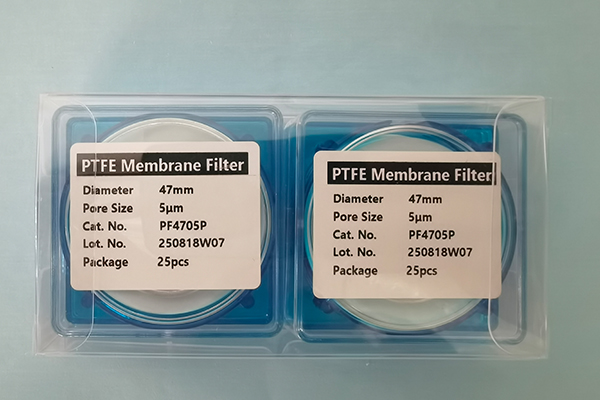
In applications like PM2.5 air monitoring, PTFE membranes capture fine particles effectively. Their hydrophobic nature ensures that data collection remains accurate, even in humid conditions. Additionally, their resistance to chemical contaminants makes them suitable for scenarios involving solvent-based sampling or acidic environments.
HuaEnv’s contributions to environmental filtration
At HuaEnv, we specialize in manufacturing high-quality filtration materials for global use. Our portfolio includes:
- Air Sampling Filters: Designed for precise PM monitoring and environmental studies.
- Quartz Filter Papers: Suitable for high-temperature and acidic conditions.
- Metone Filter Tape: Ideal for automated air quality monitoring systems.
- Hydrophobic PTFE Membranes: Perfect for air and solvent filtration.
By collaborating with distributors, we aim to provide labs and environmental services with reliable, cost-effective solutions. Samples are available to help you evaluate our products firsthand.
Conclusion
Hydrophobic PTFE membranes are indispensable for air, gas, and solvent filtration. With their unmatched chemical resistance and durability, they meet the rigorous demands of environmental monitoring and laboratory applications.
[^1]: "Hydrophilic Modification of Polytetrafluoroethylene (PTFE) Capillary ...", https://pmc.ncbi.nlm.nih.gov/articles/PMC11053467/. A materials-science source explaining PTFE’s intrinsically low surface energy and high water contact angle would substantiate why PTFE membranes are hydrophobic and suitable for filtration environments involving moisture. Evidence role: mechanism; source type: paper. Supports: Hydrophobic PTFE membranes repel water because they are made entirely of polytetrafluoroethylene (PTFE), remain dry in humid air, and are commonly used for filtering air, gases, and chemicals.. Scope note: A single source may explain PTFE hydrophobicity but may not also document all listed applications in air, gas, and chemical filtration.
[^2]: "Superhydrophobic PEEK/PTFE composite coating - ADS", https://ui.adsabs.harvard.edu/abs/2008ApPhA..91...73S/abstract. A materials-science source on PTFE surface chemistry supports that PTFE has very low surface energy and high water contact angles, explaining its hydrophobic behavior. Evidence role: mechanism; source type: paper. Supports: Hydrophobic PTFE membranes repel water because their PTFE composition gives them intrinsically hydrophobic surface properties.. Scope note: This supports the mechanism of PTFE hydrophobicity but not the performance of every commercial PTFE membrane product.
[^3]: "Wettability Studies of Capillary PTFE Membranes Applied for ... - PMC", https://pmc.ncbi.nlm.nih.gov/articles/PMC9860704/. A source describing hydrophobic membrane wetting behavior can support that PTFE resists water penetration under humid conditions, although actual wetting depends on pore size, pressure, and surface treatment. Evidence role: mechanism; source type: paper. Supports: Hydrophobic PTFE membranes remain unwetted during exposure to humid air.. Scope note: Humidity resistance is contextual; membranes may wet under sufficient pressure or when exposed to wetting solvents.
[^4]: "Development and Performance Evaluation of ... - PMC", https://pmc.ncbi.nlm.nih.gov/articles/PMC9730776/. A filtration or membrane-technology reference can document common PTFE membrane applications in air/gas venting and chemically resistant solvent filtration. Evidence role: general_support; source type: education. Supports: PTFE membranes are commonly used in air, gas, and chemical filtration applications.. Scope note: Such a source would establish typical uses, not the suitability of a specific membrane for every air, gas, or chemical stream.
[^5]: "Hydrophilic Modification of Polytetrafluoroethylene (PTFE) Capillary ...", https://pubmed.ncbi.nlm.nih.gov/38675073/. An authoritative chemical-resistance reference for PTFE supports that polytetrafluoroethylene is resistant to many acids, bases, and organic solvents. Evidence role: expert_consensus; source type: institution. Supports: PTFE membranes are chemically resistant.. Scope note: Chemical resistance varies with temperature, exposure duration, concentration, and membrane construction.
[^6]: "[PDF] PTFE Membrane Filters", https://www3.epa.gov/ttnemc01/methods/m202doc15.pdf. A membrane specification or standards-based compatibility source can support that many PTFE membranes are marketed or specified for use across approximately pH 1–14. Evidence role: general_support; source type: institution. Supports: PTFE membranes can tolerate a broad pH range, described in the article as pH 1 to 14.. Scope note: The exact pH range is product-specific and should not be generalized to all PTFE membranes without qualification.
[^7]: "Cellulose Membranes: Synthesis and Applications for Water ... - PMC", https://pmc.ncbi.nlm.nih.gov/articles/PMC11279174/. A chemical-compatibility comparison source can support that PTFE has broader resistance to many solvents and acids than cellulose-based membranes. Evidence role: expert_consensus; source type: education. Supports: PTFE membranes can filter solvents and acids that may degrade other filter materials.. Scope note: The comparison is general; individual glass fiber or cellulose filters may be treated or designed for specific chemical exposures.
[^8]: "Development and Performance Evaluation of ... - PMC", https://pmc.ncbi.nlm.nih.gov/articles/PMC9730776/. A study or technical reference on hydrophobic PTFE filtration can support that hydrophobic PTFE resists water uptake and helps maintain airflow or filtration function in humid sampling conditions. Evidence role: mechanism; source type: paper. Supports: Hydrophobic PTFE membranes maintain filtration performance in high-humidity environments better than water-wetting media.. Scope note: Performance consistency depends on aerosol composition, loading, flow rate, and membrane design.
[^9]: "Revisiting the laws of filtration: An assessment of their use in ...", https://experts.esf.edu/esploro/outputs/journalArticle/Revisiting-the-laws-of-filtration-An/99892491104826. A filtration-science source on membrane filtration can support that particulate capture occurs by mechanisms including interception, impaction, diffusion, and sieving at or within the membrane surface layer. Evidence role: mechanism; source type: education. Supports: During air sampling, particles are retained by the filter membrane as air passes through it.. Scope note: Particle capture is not exclusively surface-based for all membrane depths, pore structures, or particle sizes.
[^10]: "[PDF] Laboratory Gravimetric Analysis of PM2.5 Air Quality Filter Samples", https://dec.alaska.gov/media/xv1aq1re/gravimetric-lab-sop-final_2023_1_9_accessible.pdf. Air-monitoring methods from an environmental agency can support that PTFE filters are used in gravimetric PM2.5 and PM10 sampling protocols. Evidence role: case_reference; source type: government. Supports: PTFE filters are used in PM2.5 and PM10 air sampling.. Scope note: Agency methods specify particular filter dimensions and performance criteria rather than endorsing all PTFE membranes.
[^11]: "[PDF] Quality Assurance Guidance 2.12 - Monitoring PM2.5 In Ambient Air ...", https://www.epa.gov/sites/default/files/2021-03/documents/p100oi8x.pdf. Official ambient particulate matter sampling methods support the use of PTFE filters of approximately this size for 24-hour gravimetric PM collection and concentration calculation. Evidence role: case_reference; source type: government. Supports: A PTFE filter around 47 mm can be used to collect particulate matter for daily average concentration measurements.. Scope note: Some regulatory PM2.5 methods specify 46.2 mm PTFE filters rather than exactly 47 mm, so the citation should be used to support the general sampling format, not the exact dimension if it differs.
[^12]: "Impact of Extractables/Leachables from Filter Materials on ... - PubMed", https://pubmed.ncbi.nlm.nih.gov/36002610/. A study on extractables, leachables, or chemical inertness of PTFE can support that PTFE is generally low-extractable and chemically inert in many filtration contexts. Evidence role: general_support; source type: paper. Supports: PTFE membranes have low leaching characteristics that help preserve sample integrity.. Scope note: Leaching depends on solvent, temperature, manufacturing additives, and pre-rinsing; a source may support low extractables generally rather than proving zero contamination.
[^13]: "Review of Filters for Air Sampling and Chemical Analysis in Mining ...", https://pmc.ncbi.nlm.nih.gov/articles/PMC10174218/. Environmental monitoring guidance and membrane-material references together can support that PTFE filters are used for fine particulate collection and that PTFE is hydrophobic and chemically resistant. Evidence role: general_support; source type: government. Supports: PTFE membranes are useful in environmental monitoring because they collect fine particulate matter and offer humidity and chemical resistance.. Scope note: This is a combined claim; one source may document PM monitoring use while another may be needed for humidity and chemical-resistance properties.

