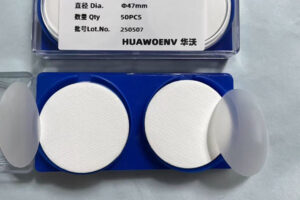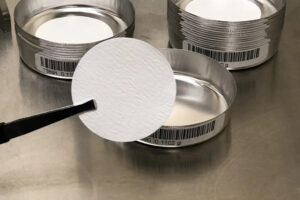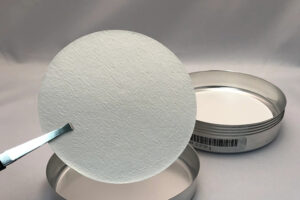

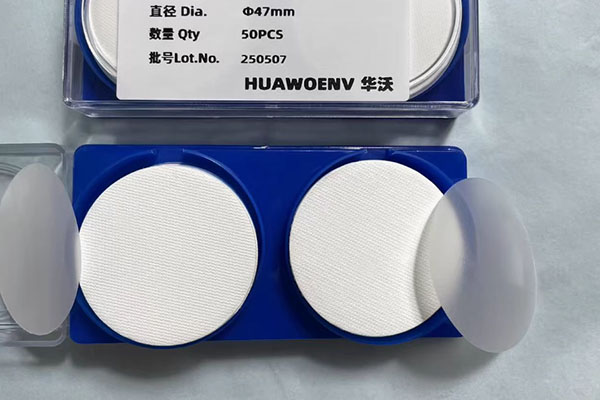
Imagine you're in the middle of a critical filtration process, and your filter clogs too quickly, halting your workflow. Frustrating, right? That's where GF/D-grade glass microfiber prefilters step in, offering the perfect solution.
Grade GF/D glass microfiber prefilters are highly efficient filtration materials designed for high particle loading and fluid flow[^1]. They provide increased flow rates, filtering speed, and excellent protection for finer membranes[^2].
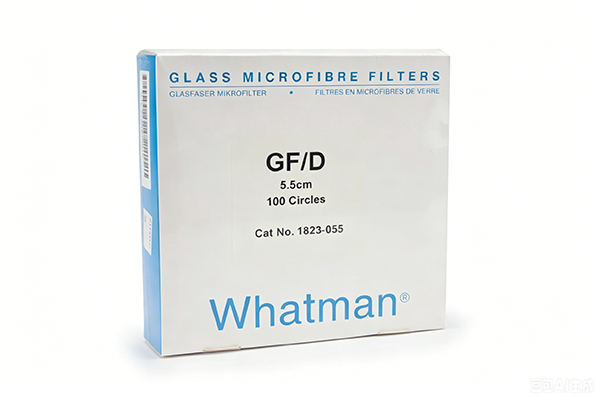
Their unique attributes make them invaluable to a wide range of applications, from air filtration to gravimetric analysis of volatile materials. Let's delve into their composition, properties, and practical uses.
What makes GF/D prefilters so effective?
Have you ever wished for a filter that could handle high particle loads without clogging quickly? GF/D prefilters are designed to meet that exact need.
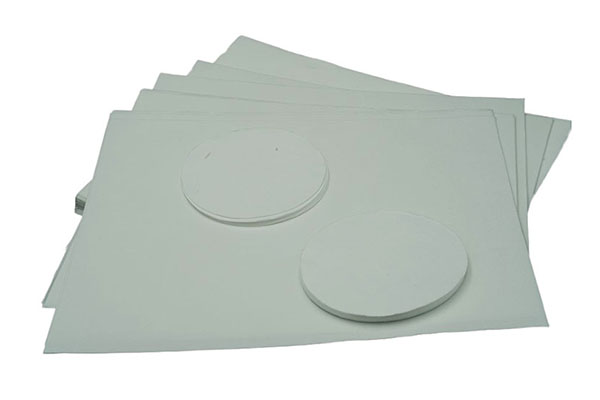
These filters are made of borosilicate glass microfiber without binders[^3]. They have a particle retention rate of 2.7 µm and a thickness of 675 µm[^4], making them ideal for processes requiring high durability and capacity.
Dive Deeper: Key Properties of GF/D Prefilters
GF/D prefilters are thick and robust, giving them an edge in high-loading capacity applications. Their structure allows them to filter large quantities of particles efficiently, which makes them ideal for tasks like air filtration and prefiltering fluid samples. A comparison table of their key specifications is below:
| Property | Specification |
|---|---|
| Material | Borosilicate glass |
| Particle Retention Rate | 2.7 µm |
| Thickness | 675 µm |
| [Maximum Temperature | 550°C](https://macro.lsu.edu/howto/Whatman-filtration-product-guide.pdf)[^5] |
| Air Flow Rate | 2.6 s/100 ml/in² |
| Water Flow Rate | 681 ml/min |
These properties enable GF/D filters to perform well under demanding conditions, such as when high-temperature or high-pressure scenarios[^6] are involved.
How can GF/D prefilters protect finer membranes?
Imagine a chain reaction where a clogged filter disrupts an entire system. This is why prefilters like GF/D are crucial—they act as the first line of defense.
GF/D prefilters catch larger particulates, preventing them from reaching finer, more delicate filters[^7]. When used in tandem with similarly sized GF/B filters, they provide even better protection.
Dive Deeper: Combining GF/D with GF/B Filters
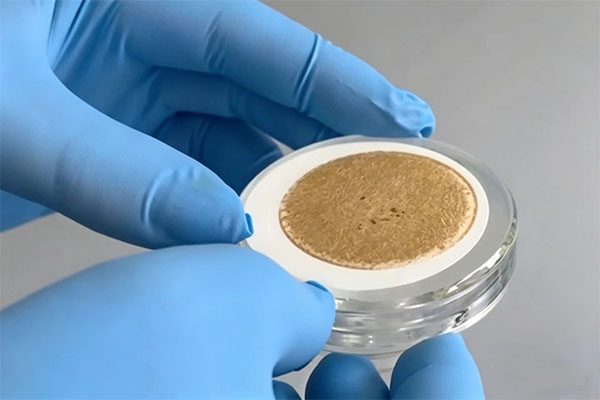
GF/D prefilters can be paired with GF/B prefilters for enhanced filtration efficiency. GF/B filters have finer retention and work well as secondary layers after GF/D[^8]. Here's how the two filters can complement one another:
- Primary Layer (GF/D): Captures larger particles, prolonging the life of secondary filters.
- Secondary Layer (GF/B): Traps finer particles for additional filtration precision.
This combination works particularly well in applications like environmental monitoring, where maintaining the integrity of delicate membrane filters is critical.
What applications are GF/D prefilters best suited for?
Filtration needs vary across industries, but certain applications demand the unique properties of GF/D prefilters. Do you work in air quality monitoring, gravimetric analysis, or fluid clarification? If so, you’ve probably encountered situations where a durable, high-capacity filter is essential.
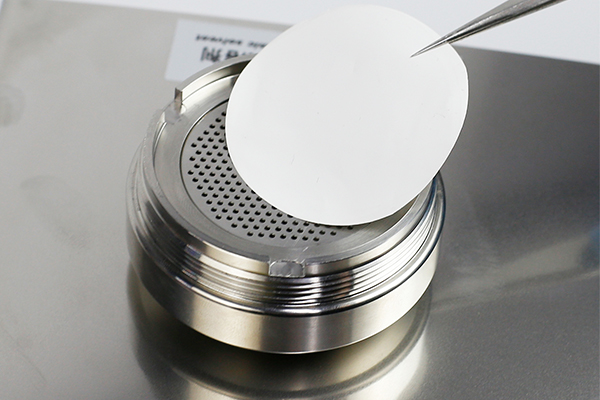
GF/D prefilters are ideal for air filtration, especially in particulate matter monitoring[^9], and for gravimetric analysis involving volatile materials and ignition[^10].
Dive Deeper: Real-World Applications
Let’s explore two scenarios where GF/D prefilters excel:
- Air Filtration: GF/D prefilters are widely used in air quality studies. They efficiently collect dust and particulates, making them perfect for PM10 or TSP sampling. Their high-temperature resistance (up to 550°C) adds another layer of reliability, especially in gravimetric analysis workflows.
- Gravimetric Analysis Involving Ignition: In processes requiring ignition, such as analyzing volatile substances, GF/D prefilters perform admirably. Their ability to handle high temperatures and retain particles ensures accurate results while maintaining sample integrity.
| Application | Recommended Filter Combination |
|---|---|
| Air Quality Monitoring | GF/D + GF/C filters |
| Volatile Materials | GF/D filters only |
| Fluid Clarification | GF/D + GF/B filters |
Conclusion
GF/D glass microfiber prefilters are a versatile, high-capacity solution for challenging filtration needs. Their robust structure and superior filtration properties make them indispensable for industries ranging from environmental monitoring to gravimetric analysis. Whether you need to protect sensitive membranes or filter large particle loads, GF/D prefilters are up to the task.
[^1]: "[PDF] Whatman filtration Product guide", https://macro.lsu.edu/howto/Whatman-filtration-product-guide.pdf. A technical specification or filtration reference for GF/D-grade glass microfiber media supports that thick glass microfiber prefilters are intended for high loading capacity and relatively rapid flow compared with finer membrane filters. Evidence role: general_support; source type: other. Supports: GF/D glass microfiber prefilters are designed for high particle loading and fluid flow.. Scope note: Such sources usually document intended use and nominal performance, not performance under every sample matrix or operating condition.
[^2]: "A Novel Empirical Fractional Approach for Modeling the Clogging of ...", https://pmc.ncbi.nlm.nih.gov/articles/PMC12029217/. Filtration references describe prefiltration as a way to remove larger particles before a finer membrane, thereby reducing clogging and helping maintain flow through the final filter. Evidence role: mechanism; source type: education. Supports: GF/D prefilters can improve flow and protect finer downstream membranes by removing larger particulates first.. Scope note: This supports the general mechanism of prefiltration rather than proving the exact magnitude of flow-rate improvement for GF/D in all workflows.
[^3]: "Whatman™ Grade GF/F Glass Microfiber Filters, Binder Free - Cytiva", https://www.cytivalifesciences.com/en/us/products/items/whatman-grade-gf-f-glass-microfiber-filters-binder-free-p-00425. GF/D technical specifications identify the medium as binder-free borosilicate glass microfiber, supporting the stated material composition. Evidence role: definition; source type: other. Supports: GF/D filters are made from binder-free borosilicate glass microfiber.. Scope note: This is a product-grade specification and does not by itself demonstrate suitability for all listed applications.
[^4]: "Whatman glass microfiber filters, Grade GF/D diam. 4.7 cm ...", https://www.sigmaaldrich.com/US/en/product/aldrich/wha1823047?srsltid=AfmBOop55fnDyMD15nxwB7WCYVawOyDGNZ7WuciikeklOmtHl_MZ6hEN. A GF/D filter specification sheet lists the nominal particle retention and media thickness values, supporting the stated 2.7 µm retention and 675 µm thickness figures. Evidence role: definition; source type: other. Supports: GF/D filters have a nominal particle retention of 2.7 µm and a thickness of 675 µm.. Scope note: Nominal retention ratings are manufacturer-defined test specifications and may not equal absolute retention for every particle type or fluid.
[^5]: "[PDF] Whatman filtration Product guide", https://macro.lsu.edu/howto/Whatman-filtration-product-guide.pdf. Technical data for binder-free glass microfiber filters reports a maximum usable temperature around 550°C, supporting the temperature-resistance specification for GF/D media. Evidence role: definition; source type: other. Supports: GF/D glass microfiber filters can tolerate temperatures up to about 550°C.. Scope note: The temperature limit applies to the filter medium under specified conditions and may not account for housings, seals, or sample chemistry.
[^6]: "[PDF] Whatman filtration Product guide", https://macro.lsu.edu/howto/Whatman-filtration-product-guide.pdf. Glass microfiber filter references support high-temperature tolerance for binder-free borosilicate glass media, but pressure tolerance depends on the filter holder, support screen, and operating setup. Evidence role: general_support; source type: research. Supports: GF/D filters can be used in demanding filtration conditions, particularly where high temperature is relevant.. Scope note: The source would support high-temperature use more directly than high-pressure use; pressure performance is system-dependent.
[^7]: "Filtration Mechanism of Fine Particle - PMC - NIH", https://pmc.ncbi.nlm.nih.gov/articles/PMC7498895/. Filtration handbooks and membrane-filtration guidance describe depth prefilters as upstream media that retain coarse particulates and reduce particulate loading on finer downstream membranes. Evidence role: mechanism; source type: education. Supports: GF/D prefilters protect finer filters by capturing larger particles before they reach the downstream membrane.. Scope note: This supports the general prefiltering mechanism and should not be read as a quantified retention claim for every GF/D installation.
[^8]: "What is a Whatman GF/ D filter?", https://huaenv.com/what-is-a-whatman-gf-d-filter/. Filter-grade specifications comparing GF/D and GF/B show that GF/B has a finer nominal particle-retention rating than GF/D, supporting the logic of using GF/B downstream in a staged filtration setup. Evidence role: definition; source type: other. Supports: GF/B filters have finer retention than GF/D and can function as a downstream layer in staged filtration.. Scope note: The comparison supports relative retention ratings, not necessarily optimal pairing for every sample or protocol.
[^9]: "Selection, Preparation and Extraction of Filter Material", https://www.epa.gov/sites/default/files/2019-11/documents/mthd-3-1.pdf. Air-monitoring methods and regulatory guidance commonly use glass-fiber or quartz-fiber filters for collecting suspended particulate matter for gravimetric or compositional analysis. Evidence role: case_reference; source type: government. Supports: Glass microfiber-type filters are used in air filtration and particulate matter monitoring workflows.. Scope note: Regulatory methods may specify filter media characteristics rather than GF/D grade specifically, so the support is contextual unless a method names GF/D.
[^10]: "[DOC] 2009_ArcLTER_TSS_LOI_Metho...", https://www.uvm.edu/bwrl/lab_docs/protocols/2009_ArcLTER_TSS_LOI_Method_v3.doc. Standard gravimetric residue methods use glass-fiber filters in drying and ignition steps to distinguish suspended solids from volatile fractions, supporting the relevance of heat-tolerant glass fiber filters in ignition-based gravimetric analysis. Evidence role: case_reference; source type: government. Supports: Glass microfiber filters are relevant to a gravimetric analyses that include volatile-material determination by ignition.. Scope note: These methods support the analytical context but may not specify GF/D as the required grade.